- Modo di Bere Magazine
- Posts
- I Learned Italian As an Adult. 🗣️🍷
I Learned Italian As an Adult. 🗣️🍷
Here's what actually helped.

Rose Thomas Bannister
January 09, 2026
It’s January, and online declarations that “This will be the year!” to finally learn a new language pepper my online feeds.
I love sharing information, so I responded at length to this question on Threads:
People who have learned new languages as an adult .. how did you do it? What helped the most?

I posted a video this week promising to share what worked for me beyond “just” taking a class.
But let’s not complicate it: your best first step is to take a class!
These are the classes I have taken personally that I found most helpful.
Italian:
Scuola Italiana del Greenwich Village
Registration happening NOW for January session. Some classes closed yesterday (sorry) but in my experience the classes are tiny. If that’s the class you want, it may be worth it to write directly and ask if they have space. Remote classes available.
Spanish:
Culture Without Borders Language Collective believe the best way to learn language is through friendship. They connect people who are learning Spanish and English through community meetups, both online and in person (NYC area).
Email Lindsay Szper [email protected] to get on her Whatsapp list.

A class on its own, however, did not get me to the moment when decided to stop hedging with “I’m not fluent” and start saying the words “I speak Italian.”
The first time filming in Italy for Modo di Bere TV, our forthcoming travel show, I was translating for intrepid videographer Emilia Aghamirzai for 14 hours a day when I asked myself what more I needed to be able to do before deciding that my Italian counts.
It wasn’t perfection. Perfection is impossible.
It was one of my favorite mottoes, come to life:
“I’m not here to show off. I’m here to communicate.”
This took ten years. I started learning Italian around 2013 at an Italian restaurant, while shining the spoons.
2013ish: Practicing at Work, for Fun
Around 2013, I started learning random words and phrases in Italian from coworkers at an Italian restaurant. No actual work was dependent on my language skills. Learning Italian was a way to blow off team and make “service" (the shift) go faster.
My first experience with Italian vowel strings was trying to pronounce “cucchiaio” (spoon) while shining silverware.
What helped the most: encouragement and positive feedback! So many cries of "Brava!" for my efforts, and only loving laughter for my mistakes.

My cocktail creator era
Mid 2010s: A Class or Two
Over the course of a few years, I took some Italian classes at a bookstore. My favorite tip was to search for unfamiliar words in Google Image instead of a translation app. Saving those images in a desktop folder with the word as a file name made for instant digital flashcards.
What helped the most: grammar, structure and commitment. “I am really doing this!”
2018: Practicing at Work, for Work
I didn’t start having dynamic Italian conversations outside of a classroom setting until around 2018, while working as a sales rep and writer for an Italian-focused wine importer.
Spending the entire day running around NYC with Italian winemakers took my Italian from party trick to useful skill.
Winemakers with strong English wanted to stick to English, so they wouldn’t tire themselves out switching languages all day.
But for winemakers whose English wasn’t as strong, it was a huge relief for them to speak Italian with me between appointments.
For the first time, I got to practice by helping someone else.
Then I volunteered for a “work-with” (sales day) with a couple who didn’t speak English at all. This meant that I would translate for the winemakers during all of our appointments.
I thought I would do well enough or I wouldn’t have volunteered, but my skills had never been tested in a professional context where no “real” Italian speaker would step in.
“He says that Aglianico is like a beast with wild blood that cannot be domesticated,” I explained to a buyer.

Thank you Filomena Iacobucci (left) for trusting me to translate for your dad (right) and mom (not pictured). Check out Terre Stregate wines!
Wow. I thought.
I’m really doing this.
That confidence boost was as heady as a gulp of strong, southern Italian wine.
If this is inspiring you, I hope you consider supporting Modo di Bere for $8 a month at patreon.com/mododibere.
Or click the button below to pay once a year and save 16%.
Why translation at work mattered: I tested my skills and helped someone else, for real stakes.
Late 2010s / early 2020s: An Intensive Class
I started taking the Saturday class at Scuola Italiana del Greenwich Village.
At the end of each class I was so tired! My brain felt sore, like after a workout. I could feel my language strength building in real time.
The mix of conversation, reading, translation, listening, spelling and writing made me work all of my skills every time.
Everyone has different strengths. I’m a bold speaker with a good accent, but comprehension of spoken Italian is much more challenging.
What helped the most: Getting out of my comfort zone. I couldn’t just show off during conversation time. I really had to work.
2019: I Finally go to Italy!
My husband and I spent our honeymoon visiting vineyards in Piemonte, Liguria, and Sicilia. The fact that I’d never been to Italy before was a big surprise to people who knew me professionally at the time, but I’d just never had the opportunity to go!
Finally standing in the vineyards I’d been studying for years and experiencing Italy with all my senses was so marvelous that I basically started this business to pay it forward by sharing that experience for all of you. :-)
We didn’t go to a single museum. It was all farms! Some wine tours were in English and some were Italian. It took great effort, but we largely understood what was going on.
What helped the most: my husband speaks Italian, too. If he didn’t, we would still have had fun, but sharing this language opened an immediate authenticity door.
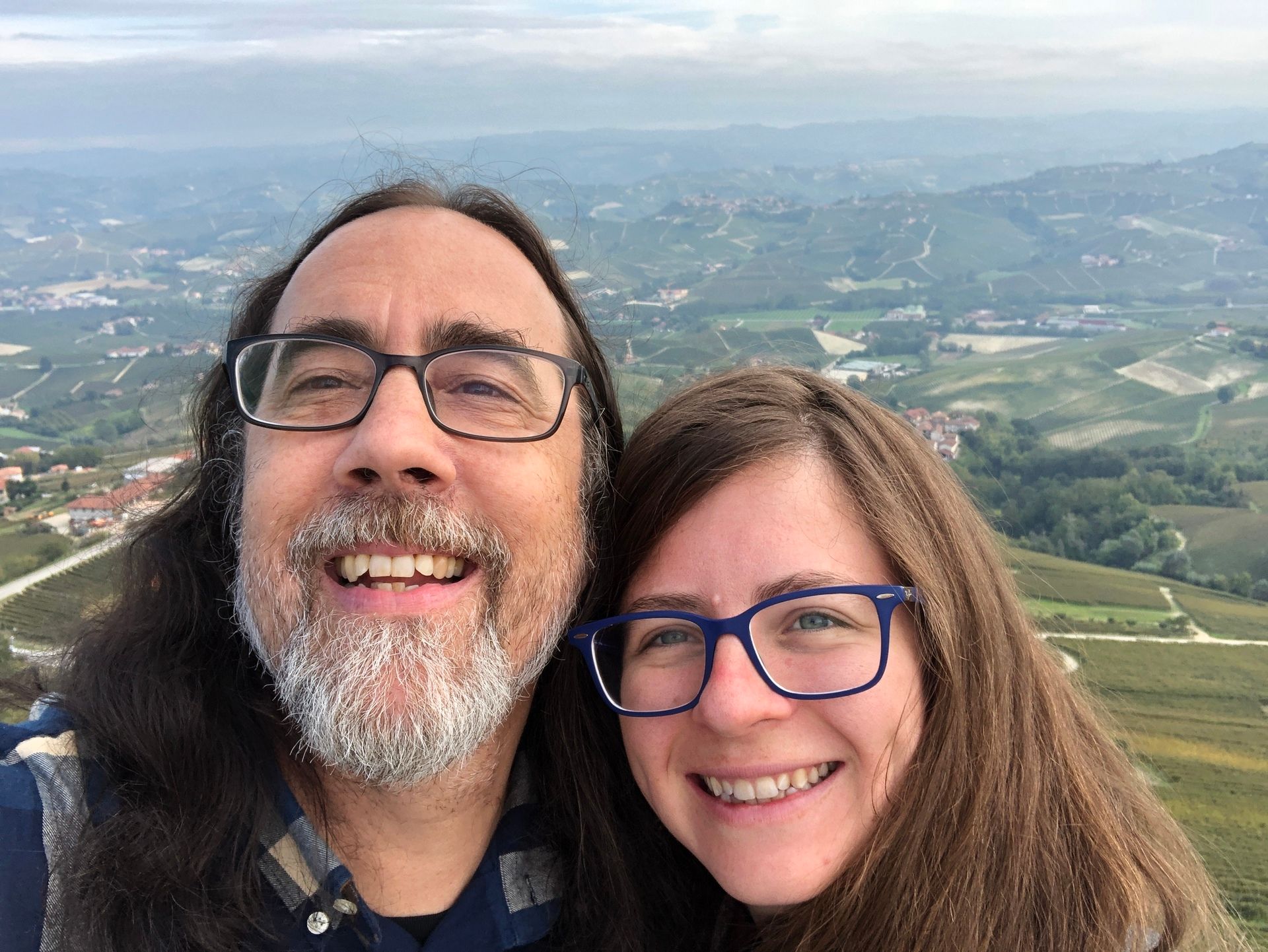
My polyglot love and me, in La Morra, Piemonte
Covid Era: A Conversation Partner
When the winemakers stopped visiting in 2020 because of Covid, I complained on Facebook that I’d lost my chance to practice. A friend connected me with a conversation partner. (Thank you, Liz!)
Terri is Canadian, but she’s lived in Italy for decades and is married to an Italian. She teaches English in Milan, so she was extra patient with my grammar questions. We communicated by weekly video call, speaking Italian until I got tired, then switching to English.
It was also fun for Terri to speak English with somebody, since she speaks Italian with most of her family and friends.
The next time I visited Italy, in 2022, my skills were far ahead of where they had been in 2019. I got the idea for Modo di Bere on that trip and started doing interviews, which went so well that I knew I could start a wine project that centered Italian wines and dialects.
I met Terri and her family in person for the first time. We got gelato and visited the Duomo. I thanked Terri for helping my Italian improve. She said, “Farina del tuo sacco” the flour from my own sack. Meaning, my accomplishment!
Why a conversation partner was the most helpful thing yet: we connected for mutual benefit, chatted as friends, and kept it going for over a year.
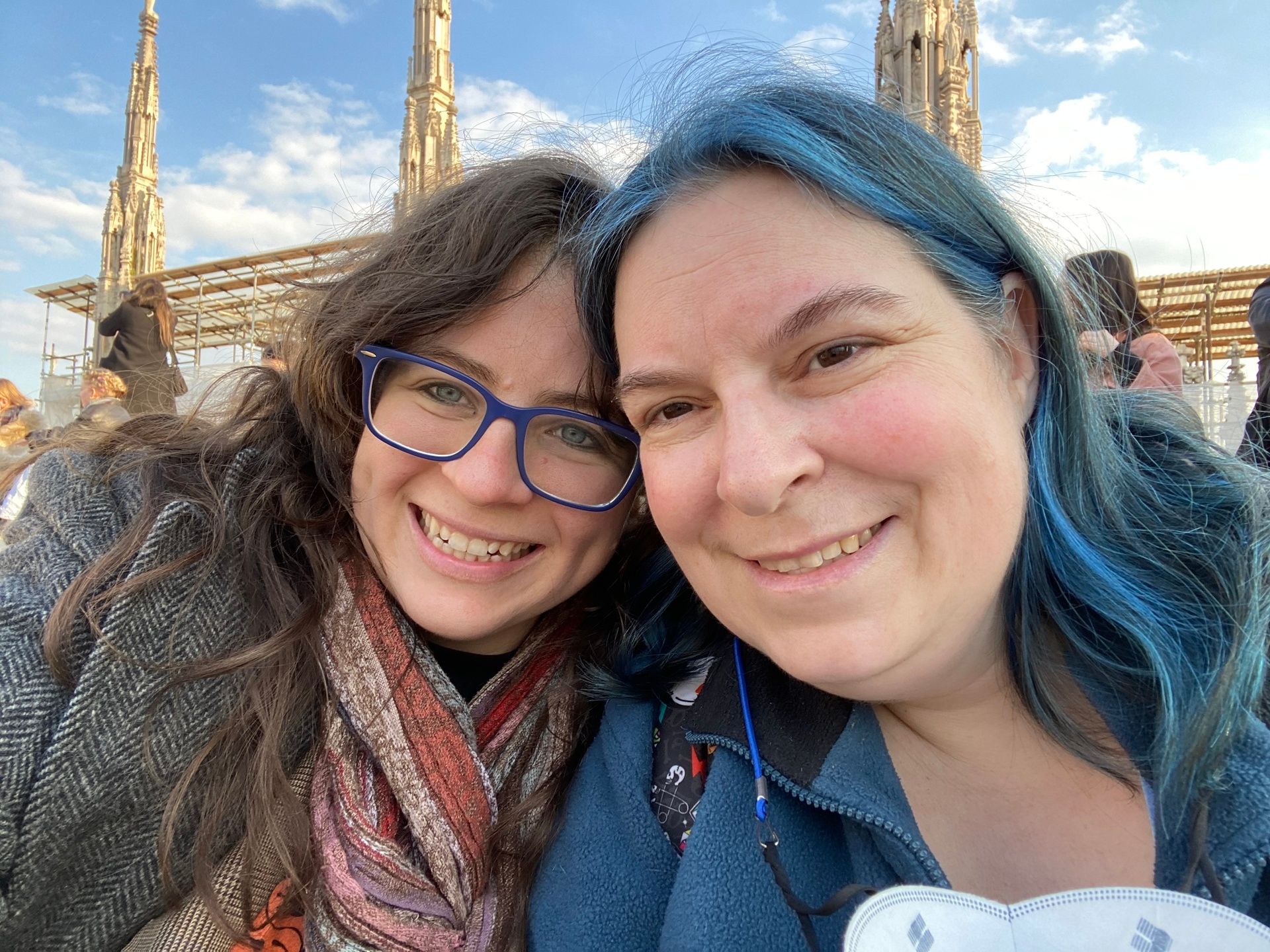
Me and Terri in Milan
Over The Years: Short Practice Bursts
Aside from my conversation partner, focused Italian practice happened in short bursts over the course of many years.
When I wasn’t signed up for a class, I stayed by listening to the bilingual Di Wine Taste Podcast, first in Italian then in English to see how much I understood.
Why that podcast helped: it was a vocabulary I was already familiar with thanks to work. It was short. I habit-stacked it with going to the gym.
Practice That Didn’t Help Much: Movies, Music, and Duolingo
I didn’t actually get much language practice from trying to watch Italian movies. I got the chance to watch a good movie, and learn something about Italian culture, but for a beginner or even intermediate language learner, movie dialogue is too complex. Maintaining linguistic attention for that long is too tiring and also ruins the movie.
Now that my Italian is really strong, watching an Italian movie might be good practice, but if you’re a beginner, stick to analyzing one scene or section, then turn on the subtitles. Same for music. Analyze for language and listen for pleasure in separate sessions.
Duolingo: I don’t want to say it didn’t help, because it’s where so many people start. It’s better than nothing. If you’re a Duolingo maniac like my husband I think you probably could more or less learn a language on there, but for me, Duolingo was always the bare minimum.
I still appreciate Duolingo when I’m too busy to practice any other way.
Starting a podcast in Italian
In 2023, I launched the Modo di Bere podcast in English and Italian. I’d done interviews in Italian before, but now I was recording and making them public.
I was so nervous.
I called Terri the night before the Italian trailer launched. (She had graciously looked over my first couple of scripts.) I was in a panic: Who the hell did I think I was to educate to Italians about Italian wine in Italian?
“I think it’s going to be okay, Rose,” Terri told me. “Italians love to hear about where they’re from.”
I guffawed. Isn’t that the understatement of the century!
I’m so glad I was brave enough to do this because the podcast was like a rocket for my Italian. It forced me to access multiple language skills: writing, speaking, and listening. I did it over and over again, with deadlines.
The obsessive process of editing the Italian podcast, which I did myself for the first two seasons, taught me the most.
Making a TV Show Inspired by Italian Wine and Language
A few short weeks after launching the Modo di Bere podcast, I took the Italian trip where I decided to stop saying “I’m not fluent.”
I traveled with Emilia, my creative partner on Modo di Bere TV, to Verona and Valtellina for our first ever shoot in Italy. I was using my translation skills again, this time from Italian to English, for everything from making friends to travel problems to complex production situations.
Of course we had some moments when people spoke English, but a big part of what makes Modo di Bere TV special is that I’m able to use my language skills to give a voice to farmers who would otherwise never be able to share their stories directly with American media.

Emilia (left) and Rose Thomas (right) with the gastronomic elites of alpine Chiavenna
This sense of purpose, and the experience of having my filmmaking partner rely on me to understand what was going on at every moment, proved to me that I SPEAK ITALIAN.
“This Train Is So Loud”
That same fall, we returned to Italy to film in Rome and Calabria. We were riding though Campania on a train when I wondered why everyone was on the train was talking so loud.
I suddenly realized that people weren’t talking louder, I was just passively understanding everything I overheard. It was like someone had turned up the volume knob on the world.
That’s when I knew that passive comprehension of spoken Italian, always my weakest skill, had become automatic.
I felt so amazed and proud.
Learning Italian Took Me Ten Years
My Italian is still a work in progress. I make basic mistakes, in public, all the time. But I can communicate, and I decided to use this as my standard. The combination of focused work and an enduring but sporadic commitment paid off in the end.
Formal classes were an essential foundation, but my skills moved ahead the fastest when I was making friends, helping others, or putting myself hugely on the spot.
Letting Go of Impossible Standards
One of the biggest factors in choosing to define myself as an Italian speaker was a mindset shift. I think I’d planned to achieve flawless, effortless Italian before I ever imagined saying “I speak Italian” without caveats or apologies. The more time I spent with multi-lingual people—and asking them about their multi-lingualism—the more unrealistic this standard seemed.
Spending Time With Multi-lingual People
Interviewing linguists, language learning experts, and speakers of rare local dialects has helped me observe how multi-lingual people move through the world. This helped me understand that a rigid and perfectionist preoccupation with who is “fluent”—and whether that matters—is an excuse to sit on the sidelines and never participate in the essential human activity of multilingual communication.
Again: “I’m not here to show off, I’m here to communicate.” That’s one of these little things that I say, and it’s never truer than when it comes to language learning.
If you really want to learn a new language in 2026, lower your standards and let go of your shame.
Move this email to your primary inbox to make sure you see the next issue! |
If you use a non-Duolingo app to practice language, reply to this email and let me know how you like it! |